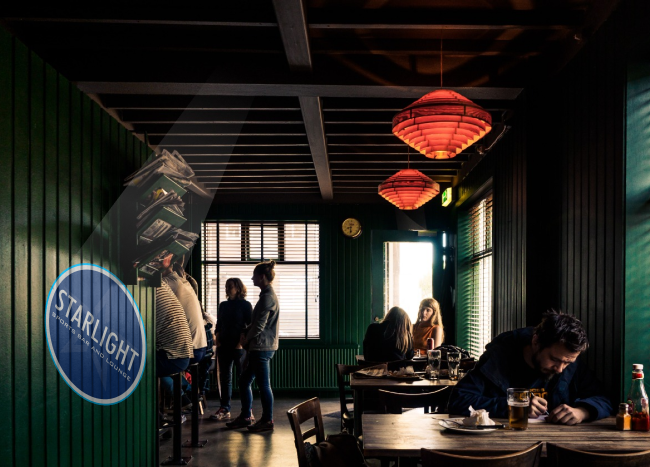
Four designs, on a building, from a quarter of a mile away.
The 4 Gobo High Wattage 1500W is our flagship taken one step further. Same 120,000-lumen engine, same long-throw optics, same ability to hold an image on a facade hundreds of feet off — but with four gobos loaded at once, cycling automatically in static mode so every projection lands square and upright, every time.
$6,888.88, with all four full-color custom gobos included free. At this scale a single fixed logo is often the wrong answer: a stadium sells four sponsor slots, a plant runs four safety messages, a hotel changes its facade with the season. One machine, four jobs, no second install.
On a small projector, swapping a gobo is a two-minute job on a stepladder. On a 1500W fixture mounted forty feet up a structure, it is access equipment, a scheduled visit and somebody's afternoon.
That changes the arithmetic completely. Four slots is not a convenience here, it is the difference between a display you can actually program and one nobody will ever change. Load four, cycle them, and the fixture does not need opening for a year.
The commercial case is just as direct: a facade that carries four sponsor marks in rotation is worth four times the surface that carries one, and re-selling a slot means a new gobo rather than a new installation.
Every projection is held completely still while it is up, then the projector advances cleanly to the next. Nothing rotates and nothing drifts, so a sponsor's mark lands upright at 300 feet exactly as it did on the first cycle.
At this distance that is not a preference, it is a requirement. A logo arriving at an angle on the side of a building is visible from the motorway, and so is the mistake.
There is no rotating 1500W. At this output the manufacturer builds the fixture as a single-image unit or as the four-gobo static one — there is no rotating 1500W and no other effect version, whatever a spec sheet may suggest.
If you only ever need one projection, the single-lens Infinity 1500W is the identical engine at $6,188.88 with two free gobos. Same output, same distance, same lens options — one slot instead of four. For a permanent brand mark on a permanent structure that is often all you need.
Lens number × distance = image width, on the standard 1:0.18 long-throw lens:
Every one of the four designs projects at the same size, so plan the artwork as a set — four marks that all read well at the same scale, rather than one detailed logo and three that get lost.
Keep the aim within about 30 degrees of straight-on. With four designs cycling this matters more than usual, because every one of them inherits the same geometry — get the angle wrong and you have not leaned one logo, you have leaned four, including somebody's sponsor mark.
Establish the angle at survey stage. Where the structure fixes it for you, keystone correction brings the projections back to square.
Same caveat as the single-lens version, and worth repeating. The fixture is heavy, draws real power and usually goes up at height: plan for a structural fixing, an electrician and access equipment. The difference is that with four slots loaded, you should need that access far less often. Send the site details through the quote form and we will work through mounting, power, lens and artwork with you before anything is ordered.
All four gobos are included free, in full color, cut from your artwork. At 1500W and long range the preparation matters: hairlines vanish, tight counters fill in, and detail that reads on a business card disappears at 200 feet. Our team rebuilds each design for the scale it will be projected at, at no charge, with proofs before anything is made.
Four slots invite programming rather than branding. Run a countdown across matchdays. Cycle the four partners who paid for the elevation, and change one when the contract turns. Put a safety message in slot four that only matters during shift change. On a landmark building, run the seasons: four graphics, one fixture, nobody back up the structure for a year.
IP65 rated, built for permanent outdoor installation and specified from −20°C to 60°C (−4°F to 140°F) — which matters more with four gobos loaded, since the whole point is not opening the fixture again for a long time.
We ship worldwide with freight included, and projects at this level are always quoted individually. Send the elevation, the distance, the ambient light and what you want in the four slots through the quote form.
Yes. Every unit is manufactured with a wide-voltage input of 110–240V AC, so it runs on standard US 120V mains straight out of the box — and on 220–240V anywhere else in the world without a converter. If you have seen figures like 24–36V or 165–265V on a spec sheet, those describe the driver's internal DC output, not the voltage at your wall.
Within about 30 degrees of straight-on — and it matters more here than on a single-gobo fixture, because all four designs inherit the same geometry. Get it wrong and you have leaned four projections, one of which is probably a sponsor's. Keystone correction handles positions fixed by the structure.
At minimum, size the power cord to the real run (6–75 ft) and take the Mean Well power supply upgrade — up to 50,000 hours, which is cheap next to the access equipment needed to reach the fixture again. Extra remotes, a waterproof timer and a switch cover are all on this page too.
Because of access. On a fixture mounted at height, changing a gobo means access equipment and a scheduled visit — so four slots is the difference between a display you can program and one nobody will ever change. It is also the commercial case: a facade carrying four sponsor marks is worth four times one carrying a single logo.
The engine, output, distance and lens options are identical. This one holds four designs and cycles them in static mode with four free gobos at $6,888.88; the single-lens 1500W holds one, with two free gobos, at $6,188.88.
It advances between them, but each projection is held perfectly still while it is up — that is what static mode means. At 300 feet a rotating logo landing at an angle is visible from the road, so static is the only sensible choice at this scale.
This is the unit we specify when the answer is hundreds of feet. Image size follows lens × distance — on the standard 1:0.18 that is 18 ft wide at 100 ft and 54 ft at 300 ft. Ambient light matters as much as distance, so send us both.
Yes. Plan the artwork as a set — four marks that all read well at the same scale — rather than one detailed logo and three that get lost at distance.
All four, free, in full color and prepared from your artwork. At this range each one is rebuilt for the scale it will be projected at, at no charge, with proofs first.
Quite possibly. This wattage earns its price on very long distances, against strong ambient light, or on very large projections. Under about 100 ft or on a genuinely dark surface, the Infinity Titan range at 150–700W is the better buy and we will say so.
A structural fixing, an electrician and access equipment — the fixture is heavy and usually mounted at height. With four slots loaded you should need that access far less often than with a single-gobo unit.
Always. Send the elevation, distance, ambient light and what you want in the four slots through the quote form and we will come back with a specification.
A building elevation is the largest surface most organizations own and almost none of them use it. Put four changeable marks on it, visible from the approach road, with nothing built and nothing permanent attached — and the wall stops being a wall and starts being inventory. Join The Projection Revolution ∞
Source: Infinity Projectors manufacturer specification sheet. Recommended daily duty cycle is not separately spec\'d by the manufacturer for this line — the LED engine is rated for continuous operation over its listed life.
A multi-lens projector allows you to load multiple gobo slides at once (4, 6, or 8), so you can rotate between different logos or messages without needing to take the projector down each time.
Use them when you want to tell a story, rotate between seasonal promotions, or alternate between logos and taglines. They are also effective in retail and hospitality where frequent updates keep the experience fresh.
Walls and floors are most popular. Multi-lens units are often used in retail stores, lobbies, and event venues where constant variety is important.
Yes, depending on the model. Some multi-lens projectors support lens upgrades such as 1:0.4, 1:0.65, or 1:1 ratios. Check the product page for details on compatibility.
Yes. Projectors are popular for weddings, projecting monograms or romantic designs. Multi-lens units can rotate between multiple wedding logos or themes.
Accessories include upgraded cords, extra remotes, mounting hardware, and protective enclosures for outdoor setups.
منح التقييم
المراجعة الخاصة بك
قم بسحب وإسقاط ملفات الوسائط الخاصة بك هنا، أو انقر للتحميل — up to 5 files, 50MB each
Company Name (optional)
Your Name
Your Email
Not published — we only use it to confirm your order and reply to you.