Nov 04, 2026
Light Through Steel: Thornburg Design Studio’s Luminaries at Ball State University
Most gobo projectors put a logo on a wall. Thornburg Design Studio hides one inside a 16-foot stainless-steel sculpture and lets the steel itself become the image. At night, a Luminary writes an entire design on the ground in a full circle of light. At Ball State University, that circle is about 75 feet across.
What is a Luminary?
A Luminary is a lantern turned into a projector. It is a tall cylinder of heavy 316-grade stainless steel, the most corrosion-resistant grade in common use. Words, an emblem, names or artwork are cut straight through its walls. Inside, under a weather-tight top cap, sits a 1500-watt Infinity Projectors gobo projector. Mirrors inside the column aim its beam at every cut.
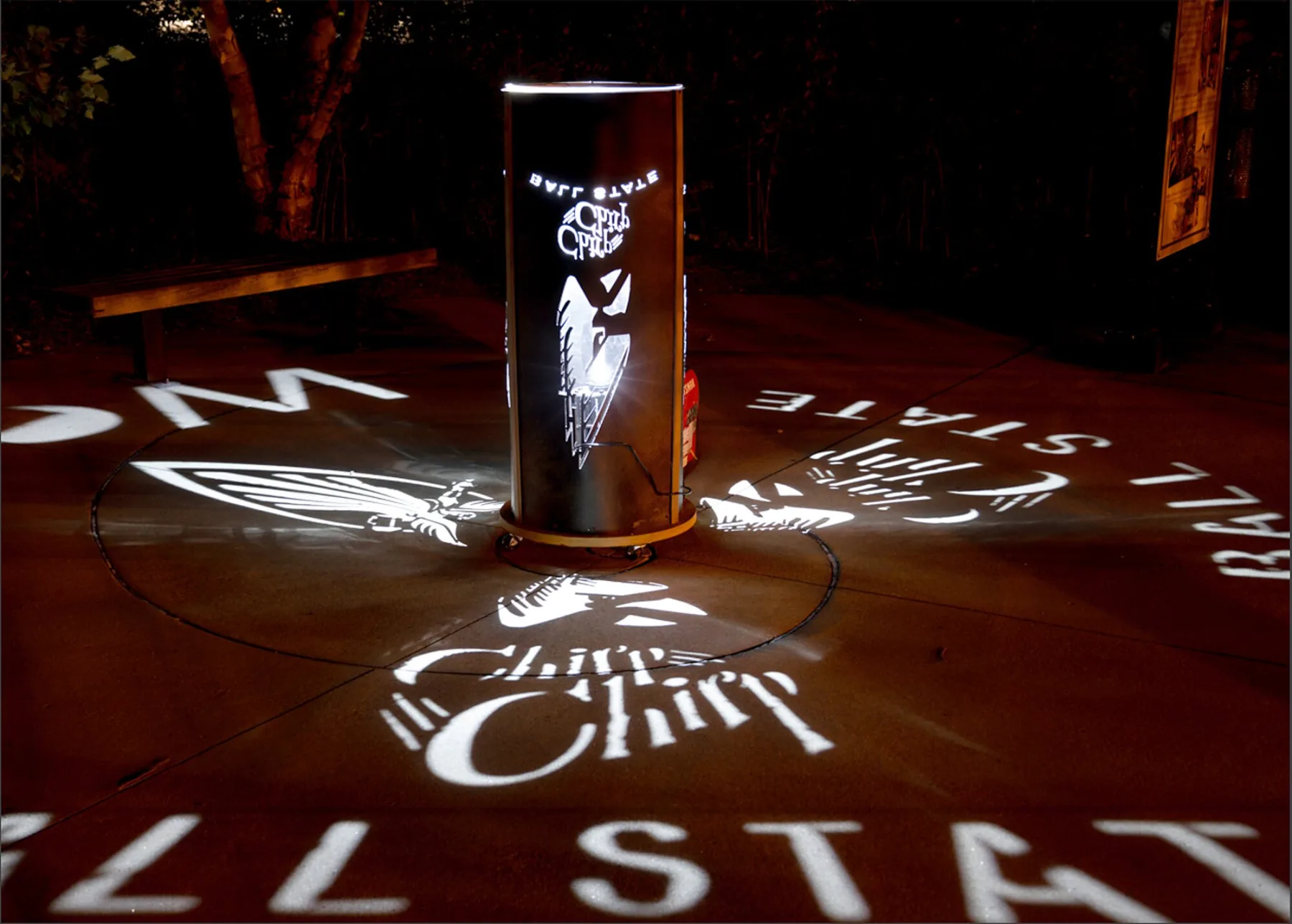
In a normal gobo projector, the design is etched on a small glass disc behind the lens. In a Luminary, there is no small disc doing the work. The steel wall is the stencil, at full scale. The light passes out through the cuts, travels down and outward, and lands as a ring of words and symbols on the grass, concrete or pavers around the base.
What makes a Luminary different
We sell gobo projectors to restaurants, hotels, cities, schools and warehouses, and we see a lot of creative installs. Thornburg Design Studio's work stands apart. Here is why:
Lumen at Ball State University
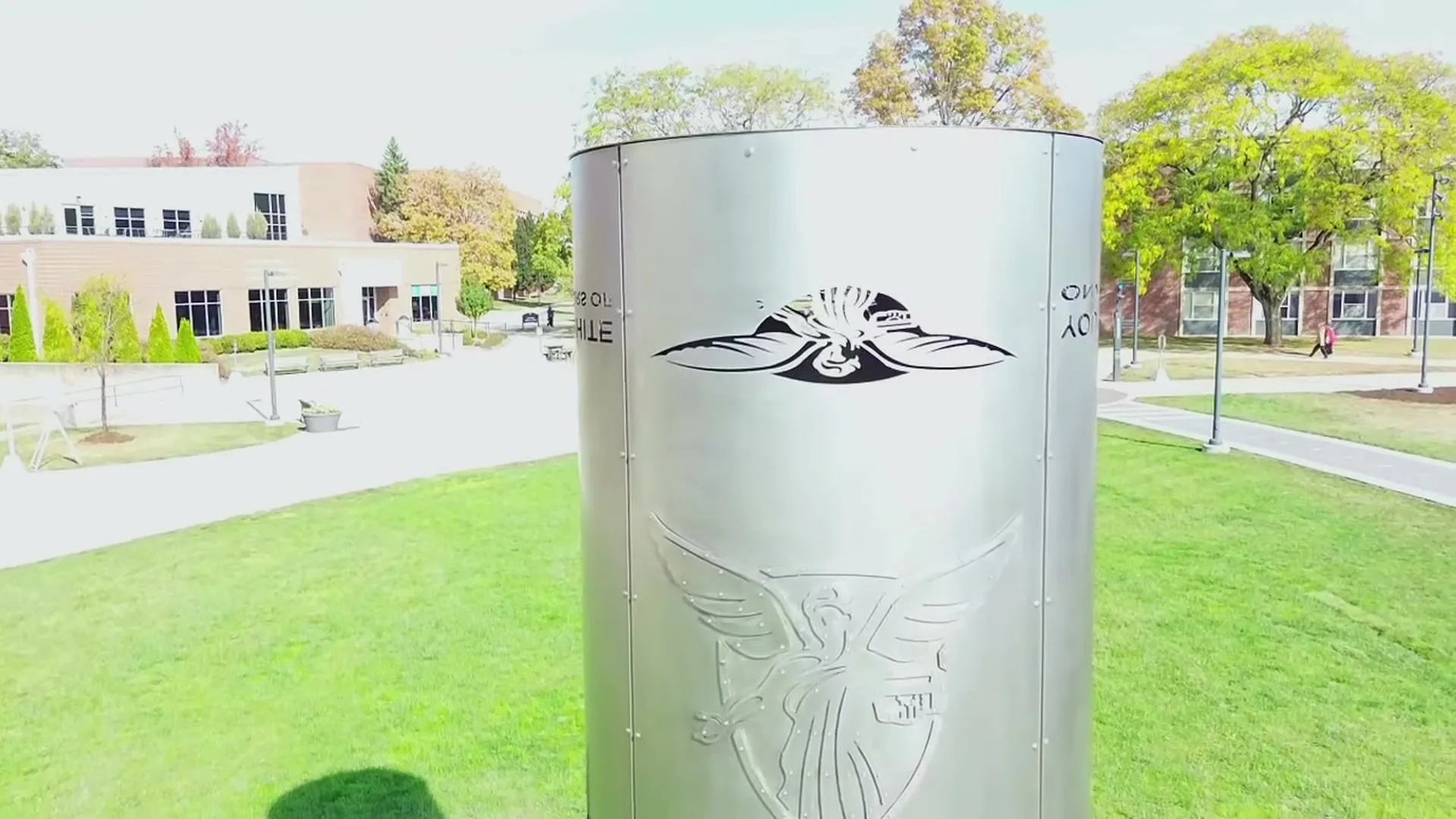
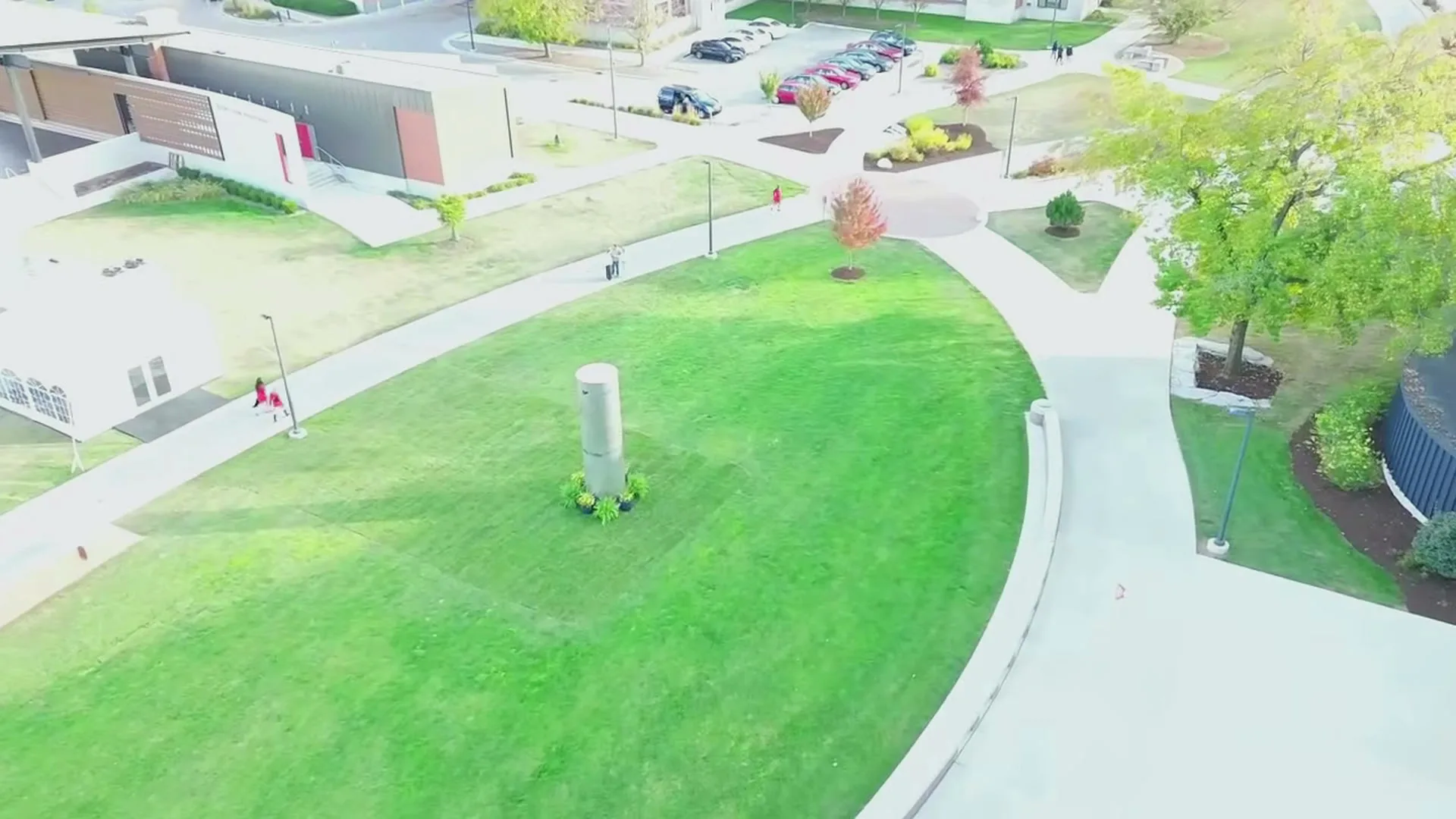
The best-known Luminary stands on the campus of Ball State University in Muncie, Indiana. It is called Lumen. The Ball State Foundation commissioned it, Ball State University's creative team designed it, and Thornburg Design Studio fabricated and installed it, including the light inside: the projector, the internal mirrors that aim it, and the geometry that lets a design cut through a curved wall land sharp on the lawn.
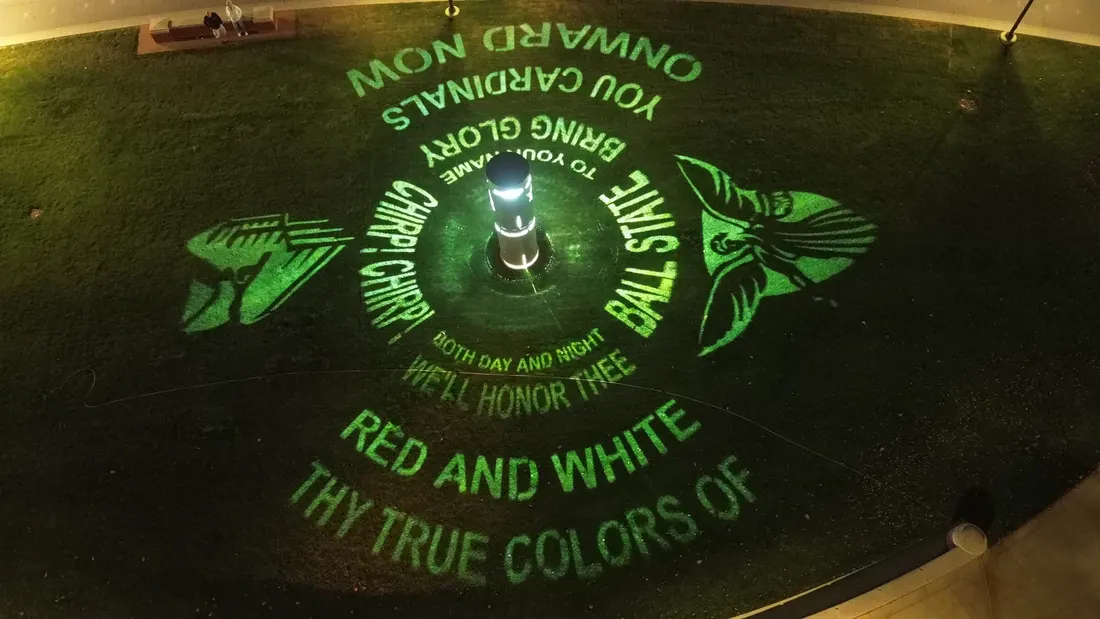
By day, Lumen is a 16-foot satin stainless-steel column with the Ball State cardinal and "Chirp Chirp" cut through it. After dark it writes the cardinal, "Chirp Chirp," the Ball State name and the university's fight song in a circle about 75 feet across. Students crossing that lawn at night walk straight through the words.
The night it was switched on
Lumen was lit for the first time at the Ball State Foundation's alumni and donor celebration for Ball State's 100th Homecoming. Pictures were kept off social media until the reveal, so before that night the light had only been switched on for a few seconds at a time, just long enough to adjust the mirrors. The studio's focus was simple: the power had to work and nothing could glitch. It came on, and it worked.
"So anxious beforehand, relieved afterwards."Charlie Thornburg, founder, Thornburg Design Studio
Lumen by the numbers
| Commissioned by | Ball State Foundation |
|---|---|
| Designed by | Ball State University's creative team |
| Fabricated and installed by | Thornburg Design Studio |
| Location | Ball State University, Muncie, Indiana |
| Height / diameter | 16 feet / 54 inches |
| Weight | About 3,800 pounds |
| Material and finish | 7-gauge, 316-grade stainless steel, satin (random-orbit) finish |
| Projected design | The cardinal, "Chirp Chirp," the Ball State name and the fight song |
| Reach | About 35 feet out from the base, a circle about 75 feet across |
| Light | Infinity Projectors 1500W gobo projector, white light, aimed with internal mirrors |
| Power | Wired into the campus pole lighting, so it switches on with the campus lights |
The first Luminary: Plainfield, Indiana
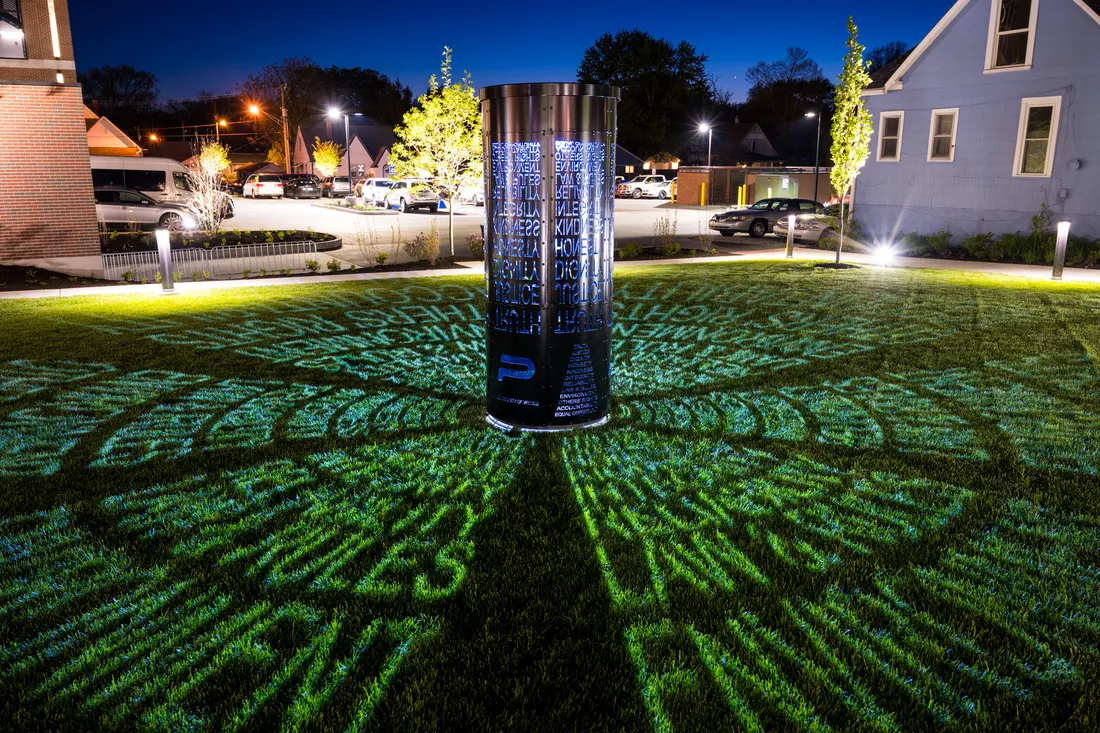
Before Ball State, Thornburg Design Studio built its first Luminary for the Town of Plainfield, Indiana: the Plainfield Core Values Lantern, on the lawn behind the town government building on Main Street. Another company had already drawn up a lighting plan for the project. One look told Charlie it would not work, so the studio engineered its own approach, the one every Luminary uses today.
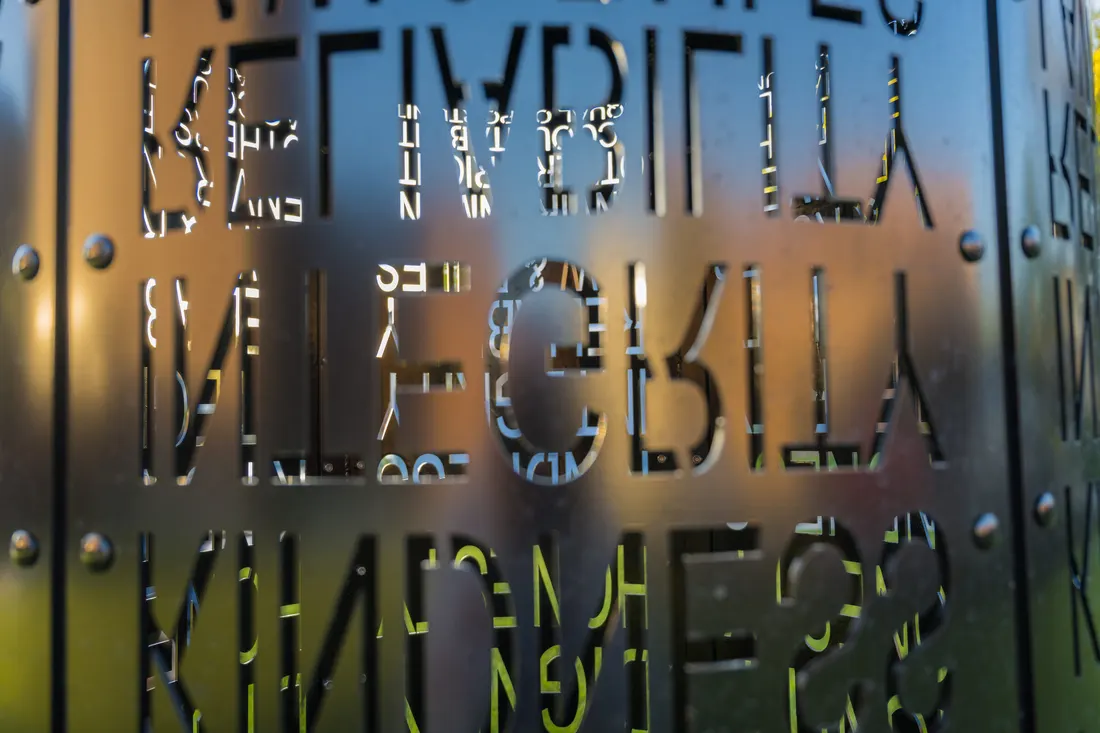
The Lantern is 316 stainless steel, powder coated black, with twelve civic values cut through its walls: Truth, Justice, Dignity, Honesty, Kindness, Integrity, Reliability, Law & Rules, Environment, Others' Rights, Accountability and Equal Opportunity. At dusk the values spread across the lawn like the spokes of a wheel, about 20 feet out from the base.
Who is Charlie Thornburg?
Charlie Thornburg founded Thornburg Design Studio in 2024 after about 20 years as a paramedic, where things have to work the first time. In the last years of that career he built custom furniture: conference tables with layered logos set in clear epoxy, fire department tables with the patch inside, and tabletops with logos that light up from within. Long before he worked in stainless steel, he was already solving the same puzzle: how to make light carry a design.
"I want people to feel completely mesmerized by it."Charlie Thornburg
How a Luminary works, step by step
- The light sits inside. A 1500-watt Infinity Projectors gobo projector is sealed inside under a top cap that keeps out rain and snow.
- Mirrors aim it. Internal mirrors direct the beam so it reaches every cut in the wall.
- The steel is the stencil. Light leaves through the cut letters and shapes, doing the job a glass gobo does in a standard projector.
- The design is corrected for the curve. Every shape is redrawn for its trip through a curved wall and down to the ground.
- It switches on with the site. Wired into pole or street lighting, it turns on and off with the lights around it.
Current Luminaries reach about 20 to 35 feet from the base. Thornburg Design Studio says reach could be pushed to 50 to 60 feet, depending on the height of the piece.
Why a 1500-watt projector
Ground projection outdoors asks a lot of a light. The design has to pass through cut steel, travel down and out, and stay readable across a wide circle, often next to campus or street lighting, through Indiana winters, year after year. That is why Thornburg Design Studio builds around our highest-output single-lens model, the Infinity 1500W Long-Distance Gobo Logo Projector: IP65 rated for permanent outdoor installation, −20°C to 60°C (−4°F to 140°F), 110–240V AC, with a long-throw 1:0.18 standard lens. Not sure what your own site needs? Try our Projector Finder or read choosing the right wattage.
Who commissions a Luminary
A Luminary suits any place with something to say and people who gather after dark. Thornburg Design Studio works with universities and schools, foundations and advancement offices, corporate campuses, memorials for veterans and first responders, hospitals, athletics programs, and cities and public art programs. Every piece is custom and priced by proposal. Each project starts with rounds of 3D renderings and a full-size, lit mock-up before fabrication, and the studio installs anywhere in the contiguous United States.
Start a Luminary
Planning a dedication, a class gift, a values statement or a landmark? Talk to Thornburg Design Studio.
Start a project with Thornburg Design Studio See more LuminariesHave your own idea for light?
Architects, artists, fabricators and lighting designers: if you have an idea that bends the rules of gobo projection, tell us about the site and we will tell you honestly what will work.
Contact Infinity Projectors Design a custom gobo See the 1500W projectorMore ideas: 10 creative ways to use logo projectors and our high-wattage projectors.
Frequently asked questions
What is a Luminary?
A Luminary is a commissioned stainless-steel sculpture by Thornburg Design Studio with words, an emblem, names or artwork cut through its walls and a 1500-watt Infinity Projectors gobo projector sealed inside. By day it is sculpture. At night it casts the whole design in a circle of light on the ground around it.
Can a gobo projector project through steel instead of a glass gobo?
Yes. In a Luminary the light shines out through the cuts in the stainless-steel wall, so the steel itself is the stencil. Internal mirrors aim the light at every cut, and each design is corrected so it lands sharp on the ground.
Why are the letters upside down on the steel?
Light passing through a curved wall stretches shapes on the way to the ground. Each design is redrawn for that trip, and the letters are cut upside down so they land right way up and read correctly on the ground.
How far does the projection reach?
Lumen at Ball State University reaches about 35 feet out, a circle about 75 feet across. The Plainfield Core Values Lantern reaches about 20 feet out. Thornburg Design Studio says reach could be pushed to 50 to 60 feet, depending on height.
Which Infinity Projectors model is inside a Luminary?
A 1500-watt Infinity Projectors gobo projector: IP65 rated for permanent outdoor installation, running from −20°C to 60°C on 110–240V AC.
Can the light change color?
No. Luminaries use white light. On grass, it reads green.
How do I commission a Luminary?
Contact Thornburg Design Studio at thornburgdesignstudio.com. Every Luminary is custom, priced by proposal, and starts with 3D renderings and a full-size lit mock-up before fabrication.
Join The Projection Revolution ∞
Complete your projector setup
Automate when it runs and protect it from the weather — both add right on any projector.