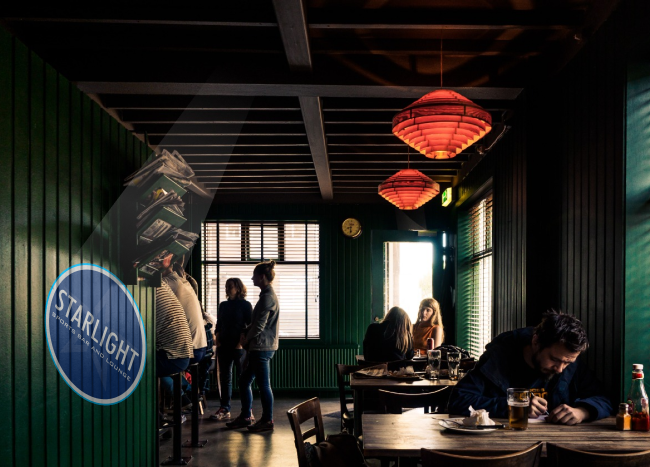
Six patterns loaded at once, in one projector, running in static mode — so every projection lands straight, square and right way up, every single cycle. Let it rotate through all six automatically, changing on its own while nobody touches it, or use the remote to hold any one projection for as long as you want. That's the whole idea: six sponsors sharing one wall, or a full calendar of messages on one surface, from a single unit that never needs a ladder. From $908.88, in ten wattages from 80W to 700W, IP65 rated for permanent outdoor use — and all six full-color custom gobos are included free, made from your own artwork.
Static and spin are two different machines here, not two settings on one. This is the static one, and the section below explains exactly why that matters before you choose.
No fabrication, no permits for a physical sign, no contractor, and no reprint invoice six months from now. Just six pieces of your brand in light, on a surface you already own. Join The Projection Revolution ∞
Sponsorships at scale. One wall, six sponsors, equal time each. You sell the same surface six times over and nobody swaps anything between slots. For arenas, clubs, event spaces and anyone monetising a facade, six is the number where a wall stops being decoration and starts being inventory.
A real content calendar. Four slots covers a logo, a promotion, a season and a spare. Six gives you room to run an actual program — logo, hours, two promotions, a seasonal pattern and a thank-you — without anyone touching the projector for months.
Where six beats four. If you have found yourself thinking "I'd need to swap gobos partway through the year," that is the signal. Six is also the tier venues land on after outgrowing a four-gobo unit on their busiest wall.
Unlike the 4- and 8-gobo units, the 6-gobo is built in one configuration: static. There is no spin version, and that is deliberate rather than an oversight.
Every projection is held completely still while it is up, then the projector advances cleanly to the next. A sponsor's mark lands upright on Monday and upright four months later, with nobody checking it.
Six-slot buyers are almost always running logos, sponsor marks, opening hours or safety wording — content that has to be read. Static is the only sensible way to show that.
Rotation belongs to decorative artwork: snowflakes, stars, seasonal patterns where "upright" has no meaning. If that is what you are after, the 4 Gobo Spin and 8 Gobo Spin both exist. Be aware of the trade: a rotating gobo returns at a different angle each cycle, which ruins a logo and suits a snowflake.
The projector shows logo 1 still, changes smoothly to logo 2 still, then 3, then 4, and back around. Each projection stays put the whole time it's on the wall, and the change between them is clean. Because nothing rotates, every projection comes back in exactly the same position — straight, square and right way up, every single cycle.
That's what you want for a sponsor mark, a company logo, anything with type in it, anything that has to look deliberate rather than decorative. This is the mode most businesses buy, and it is the model you are looking at now.
Spin shows the first logo, the logo rotates, then it advances to the next one, which also rotates, and on through the set.
Here's the part you need to know: because each gobo is turning as the unit advances, a logo does not come back around in the same position. The second time you see it, it's sitting at a different angle — not straight. There's no way around that; it's how the mechanism works.
So spin is genuinely great for scenic and holiday content — festival themes, snowflakes, seasonal patterns, decorative artwork where "straight" doesn't mean anything and the movement is the effect. For sponsorship logos and everyday business logos, go static. We'd rather tell you that now than have you unhappy with a crooked logo later.
To say it once more, because it's the part people get wrong: a static projector holds its designs still for the life of the unit. Holding each design still is what the machine does, and it's exactly why every logo lands straight. There is no 6-gobo spin variant — if rotation matters more to you than orientation, look at the 8-Gobo Spin.
There's a simple formula behind it:
Projection distance × lens size = projection size
In plain terms: the 0.25 lens makes a 2.5-foot image from 10 feet away. Multiply the lens number by your distance and that's your image width. This model ships with the 1:0.25 as its standard lens — a slightly tighter, brighter default than our four-gobo units, which suits the longer distances most six-slot installs run at.
The part most people miss: a wider lens doesn't add light, it spreads the same light over more area. So a bigger projection normally needs a step up in wattage to stay sharp. Lens and wattage get picked together — run the Wattage Finder and it sizes both at once, then we'll sanity-check it with you. The lens guide covers each lens in detail.
For a single permanent wall, the lens it ships with is the whole answer.
Order a second if the size might change. Six-slot buyers tend to be running a program rather than one sign, and programs move — a sponsor wall this season, a facade the next; a projection that starts modest and gets asked to go bigger once people notice it. A lens is minutes of work and a fraction of the cost of a second projector. Check your distances against the lens guide before you order, or send them to us and we will pick the pair.
With six projections cycling, an off-angle mount shows up six times an hour instead of once. Aim within about 30 degrees of straight-on and every pattern in the set lands square. Push past that and the whole rotation inherits the same stretched frame — which a sponsor paying for one of those slots will notice. Where the structure dictates the angle, keystone correction corrects it.
Wattage is not about how large the projection is — the lens handles that. It is about whether your projection wins against the light already on the wall.
Six-gobo installs skew brighter than average, for a simple reason: the walls worth loading six messages onto are usually the visible ones, and visible walls are usually lit ones. A sponsor wall in a concourse is not a dark alley.
Run it through the Wattage Finder before ordering — underspecifying wattage is the single most common reason a projector disappoints.
A gobo is the small glass disc that carries your artwork, and this projector holds six at once — and all six come with the projector, free. They are full color, made from your own artwork: your logo in your actual colors, not a one-color stencil. You are not buying a projector and then paying to fill it.
Gobo size is not the same across the range, and it matters when you reorder:
Tell us the wattage you own and we'll make the right size — you never have to work it out yourself. Order more gobos any time and swap the set whenever the message changes. That's the real difference between a projector and a sign: six messages live at once, and a completely different six next season, from the same hardware.
Six slots sounds like six design jobs. It isn't. Send us the logos, wordmarks and messages you already use — files, sign artwork, a photograph of a printed sign — and our team prepares each one for projection at no extra cost. You approve a proof for every gobo before anything is made.
If you are still deciding what belongs in the set, the Gobo Designer lets you build and preview each one, and the stock collection covers seasonal and decorative patterns you might want to fill the calendar with.
A good portion of six-gobo units leave the United States. Arenas and hotel groups abroad tend to find this configuration for the same reason domestic ones do: one wall, several messages, nobody maintaining it. Shipping is free to almost every destination we serve, and we handle the export documentation. Tell us where it is going and we will confirm the timeline before you order.
We also make the Infinity KaleidoScope range, which loads the same four, six or eight patterns but adds a prism that multiplies each one into repeated, mirrored projections. It's built for scenic and decorative artwork rather than brand marks — worth a look if atmosphere is what you're after. See the KaleidoScope range.
Four projections is the most popular configuration, but it isn't the only one. Two questions decide which unit you want: how many projections do you need loaded at once, and do they need to land straight (static) or is this decorative motion (spin)? Remember that static and spin are separate machines — you pick one at purchase and it stays that way, so it's worth getting right.
The full lineup is on the multi-gobo projectors page. Need serious reach as well as rotation? The multi-gobo range goes all the way up to 1500W, including a 1500W four-lens machine, so you never trade distance for the ability to change the image — see the high-wattage range.
If you only ever need one design at a time, the single-lens PowerPrince and Titan cost less. For moving effects rather than logos, see the special-effect range.
Six-gobo buyers often come back for a second and a third once the first wall starts earning. If you already know you are covering several surfaces or several properties, skip the one-at-a-time route: send the scope through the quote form and we will price the project as a whole.
Building a smaller combination yourself? Mix Match & Save discounts as you add projectors, gobos and lenses, and stacks with the existing packages.
Ten wattages and four lens options. Two decisions do the work: wattage for the ambient light, lens for the size. Then send six pieces of artwork and we handle the rest.
Four covers a business. Six starts covering a calendar — and that is a different way of thinking about the wall.
Walk the property after dark, find the surface nobody uses, and count how many things you would say on it in a year. If the number is more than four, this is the model.
Yes. Every unit is manufactured with a wide-voltage input of 110–240V AC, so it runs on standard US 120V mains straight out of the box — and on 220–240V anywhere else in the world without a converter. If you have seen figures like 24–36V or 165–265V on a spec sheet, those describe the driver's internal DC output, not the voltage at your wall.
Two ways, and you can use both. Let it rotate through all six automatically, changing on its own with nobody touching it. Or press 1 through 6 on the included remote to hold one specific projection for as long as you like. Most customers auto-cycle day to day and switch to a single logo for an event or a visit.
Static keeps every projection upright and square, cycle after cycle. Spin rotates them, which suits decorative artwork but leaves a logo sitting at an angle the second time round. Six-gobo is built static only, precisely because six-slot buyers are usually running logos and sponsor marks.
No — the 6-gobo is made in static alone, and a static projector holds its designs still. That is deliberate: six rotating patterns is a lot of movement for one surface, and almost everyone buying six slots is projecting brand marks that need to land straight. If rotation is what you want, the 4-Gobo Spin and 8-Gobo Spin cover it.
Because your logo lands straight every single time. In spin mode there's no way to guarantee the orientation when a projection cycles back around, which looks fine on a snowflake pattern and wrong on a company mark with type in it. If you're projecting a brand, static is almost always the right answer — and we'll say so even though both cost the same.
That's one of the most common uses. Six sponsors, one wall, equal time each, and the set changes whenever you re-sell it. The same surface earns six times what a printed sign would, and swapping a sponsor out means a new gobo rather than a new sign.
All six, free. Every multi-gobo projector ships with a full set of custom full-color gobos made from your own artwork — four with a 4-gobo unit, six with this one, eight with an 8-gobo. You are not buying an empty projector and then paying to fill the slots. Order more any time when the message changes.
It depends on the wattage. The 80W–150W models take 37.0 mm gobos; the 200W–700W models take 54.0 mm. Tell us which wattage you own when you reorder and we will make the right size — you do not need to measure anything.
Distance and lens set it together: projection distance × lens size = projection size. The standard 0.25 lens makes a 2.5-foot image from 10 feet away, about 5 ft from 20 ft, and about 12.5 ft from 50 ft. A 0.5 lens from those same spots gives you 5 ft, 10 ft and 25 ft. A wider lens spreads the same light over more area, so a bigger projection normally needs more wattage to stay sharp — the Wattage Finder sizes both together.
It comes down to how far back the projector sits, how big the image needs to be, and how much light is already on the surface. The darker the setting the less wattage you need — and the more the projection pops. This model runs 80W to 700W, so there is plenty of room to get it wrong in both directions. Run the Wattage Finder and we will sanity-check the result with you before you order.
Yes. Multi-unit orders, multi-site rollouts and ongoing programs are quoted directly rather than at list price. The quickest way to see it is Mix, Match & Save — add projectors, lenses, gobos and accessories in whatever combination you want and the price drops as the build grows. For anything larger or more involved, send a custom quote request through contact us with the unit count, the locations and what you're projecting, and we'll come back with pricing plus the wattage and lens spec per location. We work with a lot of customers on repeat and long-term projects and the pricing reflects that.
Yes — that's what Mix, Match & Save is for. Put a 4-gobo static on the storefront, a spin unit on the patio, extra lenses and a stack of custom gobos in the same build, and the pricing improves as you add. If you'd rather start from something ready-made, the projector packages bundle common setups.
Yes — we work with customers all over the world, and shipping is free to just about anywhere. Every unit runs on 110–240V AC, 50/60 Hz, so it works on US 120V and on 220–240V without a converter. Tell us the country and we'll send the right plug, and we'll quote distances in feet or meters, whichever you work in.
The rated operating range is −20°C to 60°C (−4°F to 140°F), which covers a Florida summer and a Midwest winter without drama. If your site sits outside that — desert heat, deep freeze, heavy coastal salt air — tell us and we'll confirm the build for that environment before you order.
Yes. IP65 across the whole range. Six-gobo units tend to go on walls that are awkward to reach, which is exactly why the weather rating matters — you should be able to mount it and forget about it for years.
Yes. Atriums, concourses and large retail interiors are common, particularly where six messages need to run without staff involvement.
About 30 degrees of straight-on or better — and it matters more here, because an off-angle mount repeats through all six projections instead of one. Keystone correction fixes what the structure forces on you.
No, and six pieces don't cost more to prepare than one. Send files, sign artwork or photographs and we set them all up for projection free, with a proof for each.
Four handles a typical business. Six is the jump you make when you're programming a calendar or selling several sponsor slots on one wall. Eight is a full year or a full roster loaded once. Worth knowing: six is static only — four and eight come both ways.
The KaleidoScope adds a prism that multiplies each pattern into repeated, mirrored projections — built for scenic and decorative artwork rather than logos. This projector is the one for brand marks.
Yes. Direct select for gobos 1 through 6 plus the auto-cycle. The layout varies a little by wattage, so ask us to confirm for the model you're ordering.
Plan on 1–2 weeks for the full order, gobos included — and note that six pieces of artwork don't take longer than one, because they're produced together.
Own it or lease it and you're free to go. Third-party structures need the owner's sign-off, and some cities regulate large or commercial projections under existing signage ordinances.
It starts from an observation most owners have never made: you own far more advertising space than you use, and all of it goes dark after six. The blank wall, the empty plaza, the whole side of a building that has been unlit every night since it was built.
A surface you already pay for can carry six different messages in a week for the cost of the electricity. That changes what a wall is — from decoration you maintain into inventory you program, and in a lot of cases into something you can sell. Join The Projection Revolution ∞
Source: Infinity Projectors manufacturer specification sheet. Recommended daily duty cycle is not separately spec\'d by the manufacturer for this line — the LED engine is rated for continuous operation over its listed life.
A multi-lens projector allows you to load multiple gobo slides at once (4, 6, or 8), so you can rotate between different logos or messages without needing to take the projector down each time.
Use them when you want to tell a story, rotate between seasonal promotions, or alternate between logos and taglines. They are also effective in retail and hospitality where frequent updates keep the experience fresh.
Walls and floors are most popular. Multi-lens units are often used in retail stores, lobbies, and event venues where constant variety is important.
Yes, depending on the model. Some multi-lens projectors support lens upgrades such as 1:0.4, 1:0.65, or 1:1 ratios. Check the product page for details on compatibility.
Yes. Projectors are popular for weddings, projecting monograms or romantic designs. Multi-lens units can rotate between multiple wedding logos or themes.
Accessories include upgraded cords, extra remotes, mounting hardware, and protective enclosures for outdoor setups.
Podaj ocenę
Twoja recenzja
Przeciągnij i upuść pliki multimedialne tutaj lub kliknij, aby przesłać — up to 5 files, 50MB each
Company Name (optional)
Your Name
Your Email
Not published — we only use it to confirm your order and reply to you.