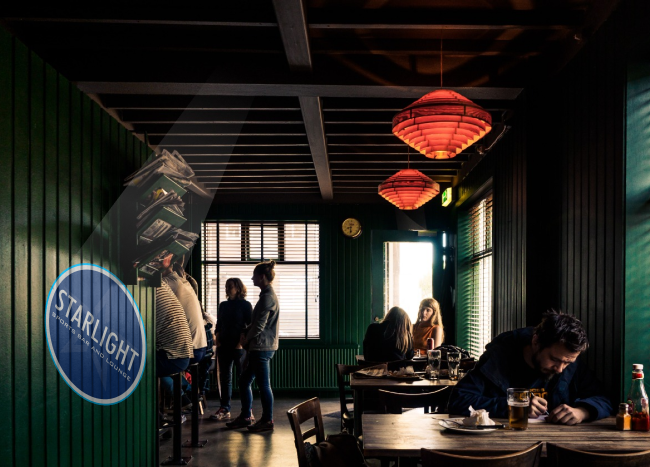
Picking a logo projector isn't about what kind of room you have — it's about distance. Measure from where the projector will sit to the surface you want your logo on. If that number lands somewhere between 4 and 16 feet, this is the one. A lobby wall behind reception. The floor inside your front door. A ceiling over the bar. The wall your customers stare at while they wait. Run your logo spinning so it catches the eye, or hold it static and razor sharp — both modes are built in and you switch between them on the remote. Starts at $278.88, comes with two free full-color custom gobos, and runs 8–10 hours a day on an LED rated up to 50,000 hours. Join The Projection Revolution ∞
There's no sign to fabricate, no vinyl to install, and nothing bolted to your wall. It plugs into a standard outlet. Your brand shows up in light on a surface you already own, and you change it in minutes by swapping a small glass disc.
This is the short-throw, indoor-only member of the family. Four power levels — 15W, 25W, 35W and 55W — and the whole range is built for the distances you actually get inside a building.
Need to cover a wall from farther back, or fight daylight pouring through a storefront window? Step up to the Infinity PowerPrince or the high-wattage range. An outdoor-rated projector works indoors with no issue at all — you're simply buying a tougher, brighter unit than the room strictly requires. That's the right call for a big ballroom, an atrium, or a warehouse aisle. For a lobby, a restaurant, a boutique, or a hallway, this one does the job for less.
It's a single-lens projector, so it shows one design at a time. If you want the image to change on its own, our multi-gobo projectors hold four, six, or eight designs in one housing and rotate through them. For moving effects instead of logos — snowfall, water ripple, drifting light — look at the special-effect range.
This projector is built for interiors and shorter distances. Lobbies, reception walls, shop floors, restaurant interiors, corridors, showrooms, event rooms — places where the throw is measured in feet rather than tens of feet, and where nothing is going to rain on it. Within that envelope it is the right tool and the least expensive way to get a clean, full-color logo on a surface.
Here is when we would tell you to buy something else. If the projector will sit anywhere exposed — outdoors, under an open canopy, near a loading door, in a dusty workshop, a warehouse, a garden center, a covered patio that still catches weather — buy the PowerPrince instead. It is the outdoor unit: IP65 sealed, aluminum housed, and built to be mounted once and left through rain, dust and heat.
The failure we see is always the same one: an indoor projector tucked under an overhang because "it never really gets wet there." Moisture and dust find it eventually. The PowerPrince costs a little more and removes the question entirely — and if you are unsure which side of the line your site falls on, describe it to us and we will tell you honestly. We would rather sell you the right one than replace the wrong one.
Static mode holds the design perfectly still, which is what you want when a logo has to read clean on a wall or a floor. Spin mode turns the projection slowly and continuously, and movement is what makes people look up — a pattern turning across a dance floor, light drifting over a ceiling, a mark that catches somebody's eye from the far side of the room. Both are built into every unit and you switch on the included remote, so the same projector suits a law office at 9am and a lounge at midnight.
Two numbers decide it: how far back the projector sits, and which lens is in it. The 0.3 lens makes a 3-foot image from 10 feet away (in industry notation, a 3.3:1 throw ratio). That's the whole idea — image width = lens number × distance.
Projection distance × lens size = projection size
Change the lens and you change the size of the projection without moving the projector an inch. Tap a lens below. Distances here are real indoor distances — the far end of the table is about as far back as this model belongs.
Lens · then units
Best for: Tight and concentrated — a door, a menu board, a tabletop
Best for: Most lobbies, entry floors and reception walls
Best for: A feature wall, or a floor mark people walk over
Best for: Broad coverage when the projector has to stay close
Best for: An image roughly as wide as the throw distance — ceilings and short-throw walls
Here's the part most people miss: a wider lens doesn't add light, it just spreads the same light over more area. So a bigger projection normally needs a step up in wattage to stay sharp. Lens and wattage get picked together, and that's something we do with you before you order. The lens guide covers each one in detail.
For a single fixed position — one lobby, one wall, one track head — one lens does the job.
A lens package is three lenses for $188.88 or five for $308.88, and indoors it is usually the smarter buy, because interiors change. A projector bought for the lobby ends up in the showroom, the corridor, the event space, the shop floor — and each of those is a different throw. One projector plus a few lenses covers the whole building for far less than a projector per room. The lens guide shows what each lens gives you at close range.
This projector holds one gobo at a time — swap it whenever you like. If you want several designs loaded together and changing on their own, that is the multi-gobo range: four, six or eight full-color designs in one fixture, cycling automatically or selected from the remote.
Interiors usually choose the angle for you — a beam, a soffit, a track position. Within about 30 degrees of straight-on the projection stays square. Past that it stretches, and on a lobby floor that distortion is very visible underfoot because people walk right across it. Slide the fixture along the track before you tilt it further, and use keystone correction where the ceiling gives you no room to.
The fastest answer is the Wattage Finder. Give it your distance, the size you want and how bright the room is, and it returns the wattage and the lens to order — about a minute, and it is the single best way to avoid buying a unit that is underpowered for the space.
Three things decide it, and they work together:
The darker the setting, the less wattage you need — and the more the projection pops. That's the one rule worth remembering. Your projection competes with every other light hitting that surface. On a dim lounge wall at 8 ft, even 15W looks brilliant and the colors come through deep and saturated. Put that same image on a floor directly under a row of retail downlights and it fades — not because the projector got weaker, but because the floor is already lit.
It runs the other way too: the lighter the setting, the more wattage it takes to make the projection pop. Indoors, be honest about two things before you pick a number. First, your ceiling lights: a boutique with track lighting aimed at the merchandise is a bright setting, not an average one. Second, your glass: a lobby with a south-facing storefront window is genuinely bright until sundown, and a projection on that floor at 2pm behaves like an outdoor one. Aim at the darkest usable surface you've got and you'll often need less projector than you thought.
A gobo is the small glass disc that carries your design. Two free full-color custom gobos come with every projector, made from your artwork. You can order more gobos any time, before or long after the projector shows up, and swapping one takes a couple of minutes. That's the real difference between a projector and a sign: your logo year-round, a holiday design in December, a sponsor's mark for one weekend, all out of the same unit.
Send a logo file, a sign file, or a photo of the sign already hanging in your lobby. Our team sets it up for projection at no charge and sends a proof for approval before the gobo is made.
Want to see it on screen first? Build it in the Gobo Designer, or start from the stock collection.
Wattage 15W–55W · lens choice, extra lenses and prism lenses · cord length cut for your mounting point, from the free 5 ft up to 75 ft · Mean Well power supply upgrade ($88.88) where the install needs to run for years untouched · extra remotes ($28.88 for a second) · power plug for your region · extra custom gobos · an outdoor waterproof timer ($88.88) if you want it switching itself on and off. Covering several areas? Projector packages bundle multiple units.
Mean Well takes the light engine from 30,000 hours on the standard supply to 50,000 hours, and the manufacturer does not recommend running them 24 hours a day — pair one with a timer if the fixture would otherwise stay on around the clock.
Restaurants, bars and nightclubs — back bars, dance floors, entry floors. Retail — store entrances, fitting-room corridors, seasonal windows from inside. Hotels — lobbies, elevator landings, and event branding that changes with the booking. Corporate — reception walls and boardrooms. Churches and events — foyers, stages, sponsor marks. Also warehouse safety, weddings, property, and civic.
Most people point the projector at the wall behind reception and stop there. That works, and it's also the least interesting thing you can do with it. Indoors, the installs that get photographed are almost always somewhere nobody thought to look:
And it doesn't have to be your logo. The same projector puts up directional arrows for an event, a countdown, a "welcome back" for a client walking in, a sponsor's mark for one night, table numbers on a floor, or a question mark on a wall three days before you launch something. Swap the gobo and it's a completely different idea.
Walk your space after the lights go down and look for the surface nobody uses — and pay attention to which corners are the darkest, because that's where a projection reads strongest. The dimmest wall you've got is usually the best canvas you've got. Join The Projection Revolution ∞
Yes. Every unit is manufactured with a wide-voltage input of 110–240V AC, so it runs on standard US 120V mains straight out of the box — and on 220–240V anywhere else in the world without a converter. If you have seen figures like 24–36V or 165–265V on a spec sheet, those describe the driver's internal DC output, not the voltage at your wall.
It starts at $278.88 for the 15W and goes to $348.88 for the 55W. Two free full-color custom gobos are included no matter which one you pick, and design help on your artwork is included too.
Three things decide it: how far back the projector sits, how big the image needs to be, and how much light is already on that surface. The darker the setting the less wattage you need — and the more the projection pops. Indoors the light usually comes from your own ceiling fixtures and from daylight through glass, so judge it honestly at the hour that matters. As a guide: 15W at 6 ft in a dim room, 35W at 10 ft in normal light, 55W at 13 ft. The Wattage Finder gives you the minimum for your exact conditions.
Distance and lens set it together — projection distance × lens size = projection size. This model ships with the 0.3 lens, which makes a 3-foot image from 10 feet away, and we also stock 0.2, 0.5, 0.65 and 1.0. So from one mounting point 10 ft back you can put up anything from about 2 ft to about 10 ft. Keep in mind that a wider lens spreads the same light over more area, so a bigger projection normally needs more wattage to stay sharp — we size the two together before you order.
Static holds the design still and sharp. Spin turns it slowly and continuously. Both are built into every unit and you switch on the remote — it's a setting, not a different product. Static is for logos and wayfinding; spin is for dance floors, ceilings, and anywhere movement earns you attention.
Sensibly, 4 to 16 feet. A 15W reads clearly to about 4 ft in a normally lit room; a 55W reaches about 13 ft in normal light and about 16 ft in a dark one. Past that the light has farther to travel and lands weaker, so the honest answer is a step up to the PowerPrince or the high-wattage range.
8 to 10 hours a day, every day. The LED is rated up to 50,000 hours, so nightly operation is measured in years. Plenty of customers add a timer so it turns itself on when the doors open and off at close.
It's rated from −20°C to 60°C (−4°F to 140°F), which covers any normal interior, plus unheated warehouses and walk-in vestibules. It has a cooling fan, so give it a little airflow rather than burying it in a sealed box.
This is our indoor model. For anything exposed to weather — a patio, a storefront facade, a courtyard — use an outdoor-rated unit like the PowerPrince. The units that fail outside are almost always indoor projectors tucked under an overhang, where moisture reaches them eventually.
No — this is the indoor model, built for interiors and shorter distances. For anywhere exposed to weather or dust, buy the PowerPrince: IP65 sealed and aluminum housed for permanent outdoor installation. The most common mistake we see is an indoor unit tucked under an overhang because "it never really gets wet there" — moisture and dust reach it eventually. If you are unsure which side of the line your site falls on, tell us about it and we will say honestly.
Shorter ones — interior distances measured in feet rather than tens of feet. Lobbies, reception walls, shop floors, corridors, showrooms and event rooms are the sweet spot. for Long-Distance Installs across a building, a courtyard or a facade, you want the PowerPrince or, at real distance, the Titan.
It depends entirely on the surface, not the hour. Aim it at a dim corridor, a shaded wall, or a floor away from the windows and it reads all day. Aim it at a floor in direct sun through a storefront window and it washes out — that's true of all projection. Pick the darkest usable surface, step the wattage up one tier for a bright interior, and it holds up.
Within about 30 degrees of straight-on keeps the image square with sharp edges. Past that it starts to stretch. On permanent installs where a beam or a soffit decides the angle for you, keystone correction squares it back up — send us your distance and angle and we'll set it up.
One lens covers a fixed permanent install. Add more if the projection will ever need to be a different size — another room, another location, an event, or simply wanting to go bigger later. A lens package is three lenses for $188.88 or five for $308.88, which is far less than a second projector and resizes the projection in about a minute.
They split one gobo into a repeating pattern: the TriScope ∞ ($188.88) gives you three copies of your design and the PentaScope ∞ ($358.88) gives you five, from a single projector. It's a fast way to fill a long wall or a ceiling without buying more units.
Two free full-color custom gobos are included with every projector, made from your artwork, and you can order more any time. Changing one takes a couple of minutes.
No. Send whatever logo file you've got — a print logo, a sign file, even a photo of your existing signage — and we'll set the gobo artwork up for you at no extra cost, then send a proof for you to approve before anything gets made. If the design needs work to project cleanly, we'll handle that and show you the result. You can also build it yourself in the Gobo Designer.
Usually not. The power supply is built into the housing and it plugs into a standard outlet on 110–240V AC. You'd bring in an electrician only for the extras — a new outlet at the mounting point, or hardwiring a permanent architectural install. Cord length is a checkout option from the free 5 ft up to 75 ft, so pick the length that reaches your outlet and skip the extension cord.
The projector with the standard 0.3 lens fitted, a remote control, and your two free full-color custom gobos made from your artwork. The remote takes a 23A 12V battery, which ships separately under battery shipping rules — grab one before the projector arrives.
Production runs 1–2 weeks from the moment you approve the art and the payment clears, because your designs get drawn, proofed and produced before we ship. Order ahead of a dated event, or start from a stock design if you're short on time.
Distance and weather decide it. This one is for indoor surfaces at 4 to 16 feet. The PowerPrince is IP65 rated for permanent outdoor life and holds up at 10 to 25 feet, so it's the pick for a patio, a storefront facade, or a big bright interior like an atrium or a ballroom.
It's how we think about light as a medium. A printed sign says one thing forever, costs money every time you change it, and ends up in a dumpster. A projector puts your brand on a wall, a floor, or a ceiling in full color, and then it's something else entirely in the time it takes to swap a small glass disc. Your logo tonight, a holiday design in December, a sponsor's mark for one weekend, a message for a grand opening. Same hardware, no printing, nothing thrown away. Every business lighting up a surface nobody else thought to use is part of it. Join The Projection Revolution ∞
Source: Infinity Projectors manufacturer specification sheet. Recommended daily duty cycle is not separately spec\'d by the manufacturer for this line — the LED engine is rated for continuous operation over its listed life.
Yes. Most projectors include a focus adjustment. You may need to fine-tune focus during setup to achieve the sharpest image.
Yes, they have cooling fans, but the sound is minimal and not disruptive in most environments.
Give Rating
Your Review
Drag and drop your media files here, or click to upload — up to 5 files, 50MB each
Company Name (optional)
Your Name
Your Email
Not published — we only use it to confirm your order and reply to you.