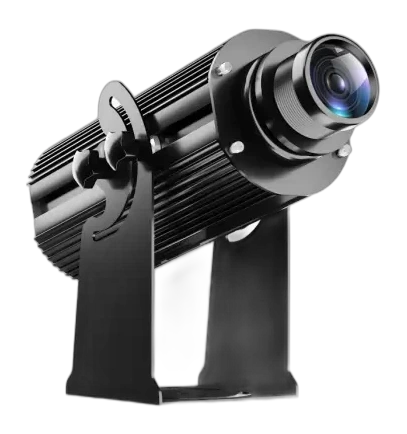
The Infinity Titan is a high-wattage outdoor gobo logo projector for long throws and big surfaces: building facades, parking lots and warehouse floors. It runs from 150W to 700W (about 15,000 to 66,000 lumens), takes a 54 mm gobo, ships with a 0.25 lens and is IP65 sealed, reaching about 40 ft at 150W and about 184 ft at 700W in average light. Two free full-color custom gobos are included, and spin or static is switched on the remote.
The Titan is the one you buy when the wall is far away and it's big. Picking a projector isn't about what kind of building you have — it's about distance, and this is our long-throw machine. Depending on wattage and how much light is already on the surface, the Titan works from about 25 ft out to roughly 350 ft. Whole building fronts. The side of a distribution center. A stadium wall from across the lot. Forklift aisles and pedestrian lanes on a plant floor. Starts at $888.88, ships with two full-color custom gobos and a remote, and runs your logo spinning or static from the same unit.
No sign to fabricate, no permit for a billboard, no scaffolding, nothing bolted to the facade. Just your brand in light, four stories tall, on a surface you already own — and you change it by swapping a small glass disc. Join The Projection Revolution ∞
Short throw — a patio wall, a storefront from the parking lot, an entrance in the 10–25 ft range? The Infinity PowerPrince does that for a lot less money, and a small dim room only needs an indoor projector. The Titan starts where those run out of reach; the high-wattage range lays them out side by side.
The Titan is single-lens — one design at a time, held big. If you want the image to change on its own, our multi-gobo projectors carry four, six or eight designs in one housing and rotate through them automatically. They go all the way up to 1500W, including a 1500W four-lens machine, so you keep every bit of the reach and add the rotation. For moving effects rather than logos, see the special-effect range.
Spin mode turns the projection slowly and continuously, and at this scale movement is what makes a whole street look up — a crest turning on the side of an arena, a pattern drifting across a plaza. Static mode holds it perfectly still, which is what you want when a logo has to read clean from 300 ft, or a safety marking has to sit exactly on the aisle. Both are built into every Titan and switch on the included remote, so the same unit brands a facade on Friday night and marks a forklift lane on Monday morning.
There's a simple formula behind it:
Projection distance × lens size = projection size
The Titan ships with the 0.25 lens as standard. At that lens, here's what the distance buys you:
That's the part people underestimate: at 200 ft on the standard lens you're putting up a 50 ft image, taller than most buildings you'd aim it at.
Change the lens and you change the size of the projection without moving the projector an inch. We stock 0.15, 0.2, 0.25 (standard), 0.33, 0.45, 0.5, 0.65 and 1.0. From one mounting point 100 ft back:
Here's the part most people miss: a wider lens doesn't add light, it just spreads the same light over more area. So a bigger projection normally needs a step up in wattage to stay sharp. Lens and wattage get picked together, and that's something we do with you before you order — not something you should have to guess at on a $2,000 purchase. The lens guide covers each one in detail.
On a fixed long-throw install, one lens sized to that exact distance is all you need.
A package pays for itself the moment there is more than one site. Titans get bought for buildings, and buildings differ — 80 feet at one, 200 at the next. A set of lenses lets the same projector cover all of them, and on a multi-site rollout that is dramatically cheaper than buying a projector per distance. Changing a lens takes a minute; specifying the wrong one and finding out on site does not. The lens guide covers every option from 0.15 to 1.0.
Keep the projector within about 30 degrees of straight-on to the surface and the image stays square with sharp edges. Push much past that and it starts to stretch — a circle turns into an egg, and at 200 ft that distortion is very visible. When the building fixes the angle for you on a permanent install, keystone correction squares the image back up. The keystone guide walks through how it works and when you need it.
Three things decide it, and they work together:
The darker the setting, the less wattage you need — and the more the projection pops. The lighter the setting, the more wattage it takes to cut through. That's the one rule worth remembering. On an unlit warehouse wall at the back of a yard, even the 150W puts up something people stop and photograph. Put that same image on a wall already washed by security floodlights and it fades — not because the projector got weaker, but because the wall is already lit. It's the number one reason a projector disappoints somebody: it got specced for the wall, not for the light on the wall.
Here's how far each wattage reaches:
The same 500W unit reaches 165 ft on a dark wall and 65 ft under stadium lighting — which is why we ask about the lighting before the building. The Wattage Finder takes all three factors and gives you the minimum that will hold up at your site.
The Titan is a family. Same idea, two genuinely different machines underneath — and a bigger flagship above them.
Reach: 50–100 ft in dark settings, 23–50 ft where it's bright. Projection size: roughly 12–25 ft on the standard lens. Housing: the compact Titan body, about 16 lbs, so a single person mounts it.
Who buys it: the business with one good wall and enough room to back off it. Apartment and community properties putting the name across the front of the building. Restaurants and venues lighting a whole facade rather than a doorway. Churches. Car dealerships. A single warehouse aisle or dock door. This is the tier most first-time Titan buyers land on, and it's the one that most often gets ordered again for the second and third building.
Reach: 165–230 ft in dark settings, 65–100 ft where it's bright. Projection size: roughly 40–57 ft on the standard lens. Housing: the heavy body, about 42 lbs — a two-person mount and a real bracket.
Who buys it: this is the volume tier for serious commercial work. Distribution centers and manufacturing plants marking wide floor zones from high steel. Whole building fronts and large outbuildings. Sports facilities, event production companies, municipalities. If the surface is a full facade or the site has parking lot lighting to fight, this is where the honest answer usually lands. It's also the tier where multi-unit orders start making sense — two or three across a long building beats one unit stretched too thin, every time.
Above the Titan sits a genuinely different machine. The 1500W Infinity flagship reaches up to 350 ft on a dark surface and puts a logo across a full building face. It weighs 134 lbs with dual air and liquid cooling, so it is rigged rather than bracketed, and it runs a single lens — 1:0.18 as standard with 1:0.40 as the alternative — instead of the eight-lens system the Titan tiers use. At 100 ft the 0.18 lens gives about an 18 ft image and the 0.40 about 40 ft (image width = lens × distance).
It is the right answer for stadiums and arenas, large festivals, municipalities lighting a landmark, and brand activations where the projection is the campaign. Because mounting position, power supply and surface all need checking first, we specify those with you before anybody buys anything — see the 1500W flagship.
Painted floor lines fade. Printed signs peel, get run over, and take days to replace — a safety gap and a recurring cost at the same time. A projected marking has neither problem: nothing on the floor to wear out, nothing for a forklift to destroy, and the message changes in the time it takes to swap a gobo.
What facilities put up with it:
This is a Titan job rather than a small-projector job because of mounting height and ambient light. Plant ceilings are high, the steel is rarely above the floor you need to mark, and the building is lit — that combination eats wattage. A 150W might cover one aisle in a dim corner; a distribution center under high-bay lighting is 500W and up, usually several.
Running more than one building is the normal case here, not the exception — we quote facility-wide and multi-site rollouts with the spec work included. See warehouse and safety signage, safety sign projectors and transportation and logistics.
The other half of the Titan's life is the grand outdoor projection — the one people photograph and share.
Whole building fronts. The facade you already own is the largest advertising surface on your property, and most nights it's dark. A Titan turns it on — and a "now leasing" message four stories tall changes on the day the building fills up. See real estate and property.
Big outbuildings. The barn, the hangar, the silo, the water tower, the back of the warehouse facing the highway — enormous, blank, lit by nothing, and usually with a hundred feet of open ground to project from. That's the ideal Titan setup, and the install that surprises people most.
Stadiums, arenas and sports facilities. Club crests on a dome, sponsor marks that change by the game, homecoming graphics on the field house. A projected sponsor mark is worth real money precisely because it changes — you sell the same surface to a different sponsor every week without printing anything. Campuses run the same play: see education and university.
Large-scale special events. Festivals, city celebrations, activations, concerts, race weekends — one Titan covers a surface that would take a truckload of printed banners, and the design changes between sessions. See events, trade shows and civic work.
A gobo is the small glass disc that carries your design. Two full-color custom gobos come with the projector, made from your artwork — your logo in your actual colors, not a one-color stencil. You can order more gobos any time, before or long after the projector shows up, and swapping one takes a couple of minutes. That's the real difference between a projector and a sign: your logo year-round, a holiday design in December, a sponsor's mark for one weekend, a safety marking on the day the aisle layout changes — all out of the same unit.
At 100 or 200 feet, artwork that looked fine on a business card falls apart. Our team rebuilds your logo for the size it will actually be projected at — thickening hairlines, opening up tight counters, dropping detail that disappears at distance — at no charge, with a proof before we cut anything.
Send whatever you have, including a photo of an existing sign. You can also preview a build in the Gobo Designer, or choose from the stock collection.
Wattage 150W–700W · lens choice and additional lenses · cord length cut for your mounting point · upgraded power supply where the site calls for it · extra remotes (one is included) · extra custom gobos · US, EU, UK or AU plug. Covering several buildings or a whole site? Projector packages bundle multiple units, and we quote multi-site rollouts directly. Turnaround is 1–2 weeks.
Warehouses and industrial safety — forklift lanes, walkways, hazard zones. Transportation and logistics — dock doors, yard lanes, loading-zone warnings. Property and leasing — building-scale messaging that changes with occupancy. Campuses — game days, seals, event branding. Events and entertainment and trade shows — festival surfaces and sponsor marks. Government and public safety — civic messaging and crosswalks. Hotels and resorts, churches, corporate campuses, healthcare, large retail, restaurants and venues, and weddings. The full list is on industries we serve.
Most people point the projector at the front of the building and stop there. That works, and it's also the least interesting thing you can do with a machine that reaches 350 ft. The installs that get photographed are almost always somewhere nobody thought to look:
And it doesn't have to be your logo. The same projector puts up a countdown before a launch, directional arrows for 20,000 people leaving a venue, a hiring message on the wall facing the employee lot, or a question mark on a building three days before you announce something.
Walk your property after dark and find the biggest surface nobody uses — and notice which corners are darkest, because that's where a projection reads strongest. The dimmest wall you've got is usually the best canvas you've got. Join The Projection Revolution ∞
Operating temperature: built for year-round outdoor use in normal commercial climates — summer heat and freezing nights included. If your site is unusual (desert heat, coastal salt air, deep freeze), tell us and we'll confirm the rating for that environment.
Yes. Every unit is manufactured with a wide-voltage input of 110–240V AC, so it runs on standard US 120V mains straight out of the box — and on 220–240V anywhere else in the world without a converter. If you have seen figures like 24–36V or 165–265V on a spec sheet, those describe the driver's internal DC output, not the voltage at your wall.
It starts at $888.88 for the 150W and moves up through the wattage tiers to the 700W. Lens choice, extra gobos, cord length and power options move it from there. Two full-color custom gobos and a remote are included no matter how you configure it. For multi-unit or multi-site orders, ask us for a package quote rather than adding units to the cart one at a time.
From about 25 ft out to roughly 350 ft, depending on wattage and how much light is already on the surface. In a dark setting: 150W reaches about 50 ft, 300W about 100 ft and 700W about 230 ft. In a very bright setting those same units reach about 23 ft, 50 ft, and 100 ft. Ambient light roughly halves your usable distance, which is why we ask about the lighting before the building.
Three things decide it: how far back the projector sits, how big the image needs to be, and how much light is already in the area. The darker the setting the less wattage you need — and the more the projection pops. The lighter the setting, the more wattage it takes to cut through. A dark outbuilding at 100 ft needs far less than a lit loading dock at the same distance. The Wattage Finder gives you the minimum for your conditions, and we'll sanity-check it with you before you order.
150W–300W is the long-throw workhorse in the compact body, about 16 lbs, for a single good wall with room to back off it. 500W–700W is the heavy body, about 42 lbs, and it's the tier that does full building fronts and lit industrial sites properly. Past 700W, the 1500W flagship is a separate product — 134 lbs, dual air and liquid cooling, rigged rather than bracketed.
Distance and lens set it together: projection distance × lens size = projection size. The Titan ships with the 0.25 lens, so at 100 ft you get about a 25 ft image and at 200 ft about 50 ft. We also stock 0.15, 0.2, 0.33, 0.45, 0.5, 0.65 and 1.0, so from that same 100 ft mounting point you can put up anything from about 15 ft to about 100 ft. Keep in mind a wider lens spreads the same light over more area, so a bigger projection normally needs more wattage to stay sharp — we size the two together.
One lens covers a fixed permanent install. Add more if the projection will ever need to be a different size — a move to another building, an event, or simply wanting to go bigger later. Changing the lens resizes the projection completely and takes a minute; buying a second projector to get a second size costs many times more. On multi-site rollouts a lens package is almost always the cheaper answer.
Static holds the design still and sharp, which is what a logo or a safety marking needs. Spin turns it slowly and continuously, which is what earns you attention on a building front or a plaza. Both are built into every Titan and you switch on the included remote — it's a setting, not a different product.
Yes, every Titan ships with a remote — on/off, timing, and mode switching. You can add extra remotes if several people need to operate the unit, which is common on multi-projector sites and event crews.
Yes, and it's one of the biggest things the Titan does. Forklift aisle warnings, pedestrian walkways, dock-door hazard zones, stop lines, no-entry footprints and PPE reminders — all as light, so there's nothing to repaint and nothing a pallet jack can scuff away. Plant ceilings are high and the building is usually lit, which is why this is a Titan job rather than a small-projector job. Our warehouse safety page covers it in full, and we quote facility-wide rollouts.
Not usually, and anyone who tells you otherwise is selling you a disappointment. One unit covers one zone well. A full facility is normally several projectors, each sized to its own aisle, dock line or walkway. That's a better outcome and it's how we quote it — send us a floor plan and we'll tell you how many and what wattage, per zone.
Up to 9 hours a day is the rated duty cycle. The LED is rated to 30,000 hours across every tier, so nightly operation is measured in years. A lot of customers add a timer or a photocell so it turns itself on at dusk, and the included remote has a timing function built in.
Yes. The whole Titan range is IP65 in an aluminum alloy housing, which is the point — these get mounted on buildings, towers and poles and stay there.
Within about 30 degrees of straight-on keeps the image square with sharp edges. Past that it starts to stretch, and at 200 ft that distortion is very visible. On permanent installs where the building decides the angle for you, keystone correction squares it back up.
Yes to both. The two included custom gobos are full color from your own artwork, and you can order more any time. Changing one takes a couple of minutes, which is the whole point — a sponsor mark this weekend, a safety marking on Monday, your logo the rest of the year.
No. At Titan distances we rebuild the artwork for the size it will actually be projected at — thicker lines, more open shapes — free, with a proof.
The Titan is single-lens, so it holds one design at a time. Our multi-gobo projectors carry four, six or eight designs in one housing and rotate through them automatically — your logo, a seasonal design and a promotion from one unit. They go all the way up to 1500W — including a 1500W four-lens unit — so you keep the full reach and add the rotation. The full lineup is on the high-wattage range page.
If you own it or lease it, there's nothing to arrange. Projecting onto a structure you don't control needs the owner's permission, and at Titan scale it's worth checking local sign and lighting rules — some municipalities treat a building-sized projection the way they treat signage.
Custom designs get drawn, proofed, and produced before we ship, and projector turnaround is 1–2 weeks. Order ahead of a dated event. Stock designs ship faster if you're short on time, and they already include the common safety symbols.
It's the belief that every business is standing in front of a canvas it has never thought to use. Look at your property after dark and you'll find them everywhere — the blank wall, the empty plaza, the water tower, the whole side of a building that has been dark every night since it was built. A printed sign says one thing forever, costs money every time you change it, and ends up in a dumpster. Light doesn't work that way. It lands wherever you point it, in full color, at any size, and becomes something else entirely in the time it takes to swap a small glass disc.
That's the invitation: stop thinking about where a sign would go, and start thinking about what you could turn a surface into. The businesses that get this right don't just advertise — they transform the place people are standing in, and their brand becomes part of the experience of being there. Your logo tonight, a holiday design in December, a welcome for the client flying in tomorrow, a message nobody expected on a wall nobody was looking at. Every business that lights up a surface others walked past is part of it. Join The Projection Revolution ∞
Distance decides it. The PowerPrince is built for 10–25 ft — storefronts, patios, entrances, courtyards. The Titan starts where that runs out: whole building fronts, big outbuildings, stadiums, plant floors from high steel, and anywhere you're fighting real ambient light. Send us the distance and the lighting and we'll tell you honestly which side of that line you're on.
POWER 150W
Model
IP-DGL-150
Light source
Power LED
Color Temperature
8000-8500K (Default 8500K White Light)
Lamp Luminous Efficiency
12000 – 14000 lm
Projection Ratio
1:0.25 (Default) – 1:0.15 | 1:0.2 | 1:0.33 | 1:0.4 | 1:0.65 | 1:1.0 | 1:1.3 (update)
Rated Voltage
AC 165-265V 50/60Hz
Shell material
Aluminum alloy
Cooling system
Aviation Cold Forged Aluminum
Gobo Size
54mm
Light Source Life
30000 Hours (Working at most 9 hours per day)
Color
4K
Waterproof Level
IP65
Single/Multi Gobo
Single
Static / Rotate
Rotate
Working Temp
20 - 60 0C
Equipped with remote control
control ON/OFF, Timing, Switching function
Weight
16.09 Lbs
Product Size
15.35" (39 cm) x 10.7" (27.2 cm) x 7.63" (19.4 cm)
POWER 200W
IP-DGL-200
18000 – 20000 lm
POWER 300W
IP-DGL-300
27000 – 30000 lm
POWER 500W
IP-CDGL-500
35000 – 50000 lm
41.88 Lbs
16.37" (42.5 cm) x 15.2" (38.7 cm) x 11.1" (28.2 cm)
POWER 700W
IP-CDGL-700
60000 – 66000 lm
Volume pricing is automatic: the more units of one model in the cart, the lower the price of each one. Price each, as checkout charges it:
Ordering 100 or more? Large projects get their own quote: request project pricing. Layout planning is free: send a floor plan, photos or run lengths and we draw where each unit mounts and how many you need. How volume pricing works.
Yes. Most projectors include a focus adjustment. You may need to fine-tune focus during setup to achieve the sharpest image.
Give Rating
Your Review
Drag and drop your media files here, or click to upload — up to 5 files, 50MB each
Company Name (optional)
Your Name
Your Email
Not published — we only use it to confirm your order and reply to you.